
朝5晚9
‘Overcapacity’ claim groundless as China’s green tech fuels global growth: Tian Xuan_我的网站

A |
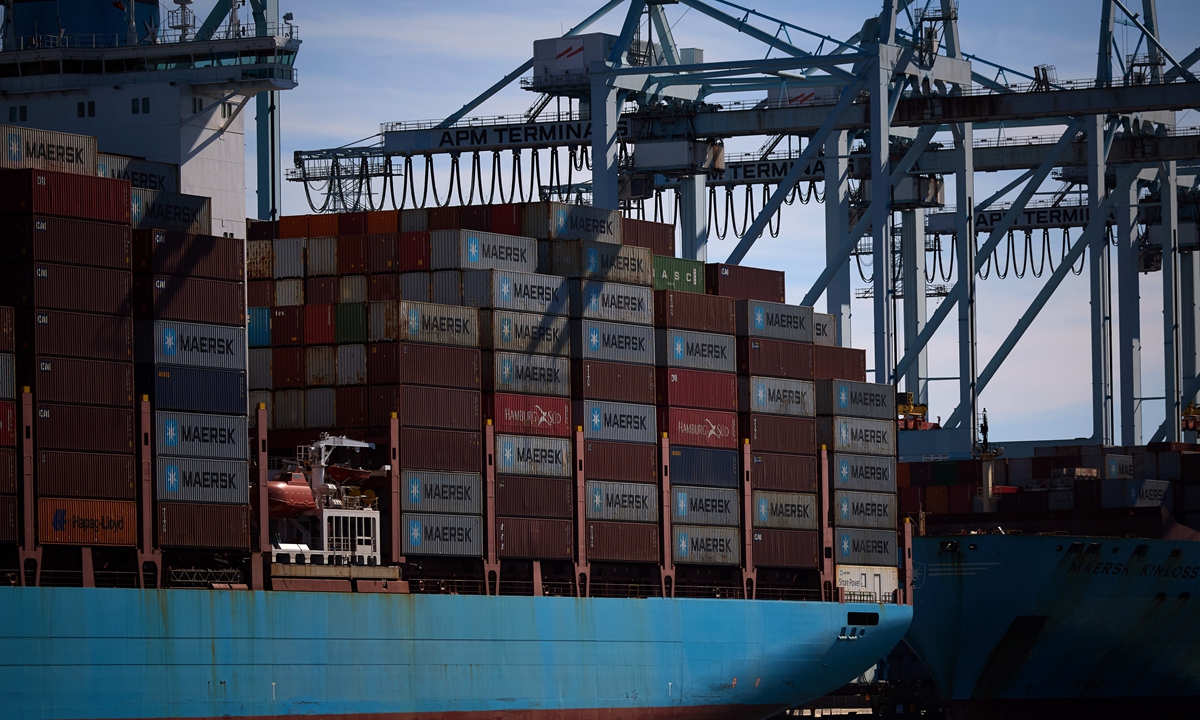
When even major US allies and trading partners are swept into Washington's alleged China-linked transshipment network, is the US still cracking down on its so-called illegal tariff evasion, or is it raising its "small yard, high fence" higher and tighten it further by wielding its tariff stick and extending tariff controls across normal global supply chains?
The White House on Thursday released a report identifying roughly 40 economies as participants in what it calls a "Shadow Transshipment Network", alleging that Chinese goods are being routed through third countries to evade higher US tariffs. The list stretches across Asia, Europe and the Americas and includes some of Washington's closest allies and largest trading partners.
Chinese experts said the report is partly aimed at defending Washington's tariff policy by shifting responsibility for its weakened impact onto other economies, while also pressuring them to follow US trade and origin rules. In effect, the US is trying to extend its unilateral trade restrictions beyond its own borders and deeper into global supply chains, they said.
Build 'higher fence'
The 25-page report claims that US import sourcing saw a "substantial reallocation" after the 2018 tariffs, as China's direct share declined and imports from identified transshipment economies rose. It alleges that some goods were routed through lower-tariff jurisdictions, where minor processing, relabeling, repackaging, re-invoicing or paperwork changes were used to create the appearance of a new national origin.
However, the report itself acknowledges that alleged transshipment risks in several major economies are "embedded within broad legitimate trade flows." It also admitted that the post-2018 shift in US imports "does not establish" that all displaced Chinese trade was illegally transshipped and partly reflected "legitimate changes in production, investment, and sourcing."
False declarations of origin or simple repackaging can amount to tariff circumvention, but investing overseas, building factories abroad or sourcing components across borders are legitimate forms of supply-chain adjustment, experts said.
One purpose of the report is to portray Washington's tariff policy as effective while attributing its diminished impact to the responses of other economies, Zhou Mi, a researcher at the Chinese Academy of International Trade and Economic Cooperation, told the Global Times.
This allows Washington to shift responsibility onto other economies and put itself in a more favorable position in shaping the narrative around its tariff policy, Zhou said.
Cui Fan, a professor at the University of International Business and Economics, told the Global Times that US rules for determining country of origin are not fully aligned with those used by other economies. The latest move could pressure other countries to adopt US standards, but Cui said such an approach is unlikely to work.
"Countries formulate their rules of origin based on a range of factors, including the scale and technological conditions of their own industries," Cui said. "Industrial structures and the global division of labor cannot be reshaped simply through pressure from one country."
Harmonization of rules of origin - applying the same rules across countries regardless of purpose - "would facilitate the flow of international trade," according to WTO on its website.
It has also warned that misuse of such rules may turn them into "a trade policy instrument" rather than merely a device supporting other trade policy measures, according to WTO.
Washington was pursuing hegemonic politics and unilateral bullying in the economic and trade sphere under the guise of "reciprocity", a spokesperson for China's Ministry of Commerce said when commenting on the US use of tariffs to pressure other countries into restricting economic and trade cooperation with China.
Disrupting global supply chains
Cui said production and trade networks linking China with South Korea, Europe and other economies have taken shape over years of market-driven specialization. By lowering production and logistics costs and improving efficiency, these networks have benefited businesses and consumers across participating economies.
"The real challenge facing global trade today is not so-called illegal transshipment, but the continued damage that unilateralism and trade protectionism are inflicting on the multilateral trading system," Cui added.
Since returning to office, the Trump administration has made tariffs a centerpiece of its trade policy, rolling out sweeping "reciprocal tariffs" and other broad duties that have drawn widespread criticism at home and abroad. On Thursday, Washington announced new Section 232 tariffs on drones and their parts and components, further expanding the range of products subject to US tariffs.
US tariffs have themselves pushed companies to reconfigure supply chains. Washington is now citing those very adjustments as evidence of circumvention, effectively using the market fallout from its own tariff policy to justify further trade restrictions, Chinese experts noted.
International trade is based on mutual benefit, and sovereign countries have the legitimate right to conduct economic and trade cooperation independently, Cui said. "No country should interfere with normal global trade simply to advance its own unilateral interests."
The report broadens its scrutiny beyond routing and documentation to include China-origin inputs or components, Chinese ownership or financing, relationships with Chinese suppliers or manufacturers, China-based production steps and China-origin routing histories.
Analysts believed the latest move is more than simply making the existing "high fence" higher. By trying to bring more economies and a larger portion of global supply chains within the reach of US tariff enforcement, Washington attempted to make the "yard" itself much bigger.
Cui warned that sustained US pressure to reshape normal trade and supply-chain links could fragment mature regional production networks, and reduce the efficiency of global resource allocation, with the impact extending far beyond China-US trade given the wide range of economies named in the report.
Zhou noted that companies would be forced to redesign supply chains to manage rising policy risks, adding costs that could feed back into the US through higher inflation while creating broader frictions and instability for global trade.
。

In economic theory, "overcapacity" - for which no universally accepted definition exists - is inherently a recurring feature of the market economy's dynamic "balance - imbalance - rebalance" cycle. The Western narrative that equates China's sizable production capacity directly with "overcapacity" defies economic logic and rigor; in reality, it represents a politicization of trade and economic issues.
First, it confuses the concepts of "capacity scale" and "overcapacity." China's overall industrial capacity utilization remains within a reasonable range. Periodically lower utilization in traditional sectors reflects a normal adjustment as these industries advance toward high-end, intelligent, and green production. Ample capacity in certain emerging industries is precisely what meets surging global demand for high-end, smart, and green solutions. Therefore, equating scale with excess is typical equivocation.
Second, "overcapacity" itself is a dynamic feature of market economies, where no fixed balance persists indefinitely. Judging capacity based solely on static snapshots violates basic economic principles.
Third, it is erroneous to simplistically link trade surpluses or industrial subsidies to overcapacity, while ignoring the macro context of global specialization and cross-border savings-investment structures. It also disregards the reality that reasonable capacity utilization ranges differ across economies at varying stages of development. Imposing a single standard on China is neither scientific nor rigorous.
China's global competitiveness in green technology stems from sustained, large-scale investment in innovation, a comprehensive industrial and supply chain system, massive application scenarios, and intense market competition - not from alleged government subsidies. After decades of long-cycle R&D, Chinese industries have achieved breakthroughs in core technologies such as power batteries and photovoltaic modules.
During the 14th Five-Year Plan period (2021-25), China's nationwide R&D spending grew at an average annual rate of 10 percent. Economies of scale have continuously diluted production costs. China's ultra-large domestic market and full-chain supporting ecosystem provide an optimal testing ground for new technologies - from pilot verification to mass deployment. With more than 200 million market entities driving fierce competition, enterprises are constantly compelled to cut costs, raise efficiency, and upgrade products, thereby forging dual advantages in price and performance that we see today.
There is no direct causation between subsidies and overcapacity. Industrial subsidies are a globally recognized practice, typically aimed at correcting market failures and advancing critical technologies. China's subsidies are granted on an impartial basis to all types of market entities, in full compliance with WTO rules, and have not triggered disorderly capacity expansion.
Currently, capacity utilization in China's green industries remains within a reasonable range. Support is primarily directed toward R&D, technological breakthroughs, and consumer-side incentives through market-based mechanisms - not toward fueling overcapacity. Crucially, China's high-quality capacity has reduced the global cost of green transition, representing an opportunity rather than a shock to world development.
Against the backdrop of global carbon neutrality goals, labeling China's new energy capacity as "overcapacity" is entirely untenable. According to the International Energy Agency, global data center electricity consumption will approach 1 trillion kWh by 2030, with 40 percent of incremental power needing to come from renewables. Demand for wind power, photovoltaics, power batteries, and related green energy solutions remains far from saturated - so claims of "overcapacity" are groundless.
China's capacity plays a central role in advancing the global energy transition. Over the past decade, the levelized cost of electricity from wind and solar globally has fallen by more than 60 percent and 80 percent respectively - improvements largely attributable to Chinese innovation and manufacturing, which have directly lowered the cost threshold for worldwide green transformation.
The US journal Science crowned the global renewable energy surge led by China among its Top 10 Breakthroughs of 2025. Leveraging its technological and scale advantages, China is well positioned to supply abundant, high-quality green energy equipment and solutions, meet fast-growing renewable demand from data centers, industrial production, and other sectors, and tangibly support countries in implementing the Paris Agreement. In short, China is a pivotal force driving the global low-carbon transition.
The so-called "China Shock 2.0" is fundamentally a protectionist narrative rooted in Cold War thinking - a politically motivated claim inconsistent with facts. The rapid development of China's modern industries is driven by innovation and sustained institutional reform, not by dumping allegedly excess capacity abroad. Rather than posing a shock, China's industrial progress offers a "China Opportunity 2.0." It delivers multiple dividends to global development - innovation dividends, market dividends, and growth dividends - while injecting stability and vitality into global industrial chains through an open and win-win approach.
China's high-quality green and high-tech exports have tangibly accelerated the global green transition and reduced production costs worldwide. Meanwhile, as the world's largest goods consumption market and the second-largest importer for 17 consecutive years, China provides enormous market opportunities for economies around the globe. Moreover, China's open-source collaboration and technology sharing in frontier fields such as artificial intelligence and the digital economy enable developing countries to bridge the digital divide at lower cost and share in the benefits of the technological revolution.
The facts demonstrate that China's emerging technologies and products represent a "China Opportunity 2.0" - driving global technological progress, accelerating the green transition, improving livelihoods across nations, and bolstering the industrialization of developing economies. This open and mutually beneficial cooperation stands as the true engine of global economic recovery and sustainable development.
This article is compiled based on an interview with Tian Xuan, dean at the Guanghua School of Management and Boya Distinguished Professor of Finance of Peking University. [email protected]
。
Current article:http://63gu.linxiuhuaishuangniuzhenrua.bond/list_lxu2g/r027.html
Published on:03:40:50


1
U18男篮亚洲杯最佳阵容:张懿赵杰入选 澳大利亚两人巴萨兰MVP2
多部门发文进一步保障农业灌溉用水安全3
于海田主持召开市政府常务会议 研究优化营商环境等事项4
51岁"最美变性艺人"河莉秀谈婚姻 离婚9年不想再婚5
科比48岁生日 球迷送祝福“老大生日快乐”6
花间颂粉饼过敏商家恶意拒退款7
2025京东618活动哪天最划算?是5月30晚8点买最便宜还是6月18日当天买最划算?8
Iraqi man arrested in Germany over alleged involvement in war crimes as a member of IS9
快船声明:没向小卡输送资金 没安排人代付报酬10
这个防过敏“神器”火了!医生提醒→11
特斯拉在伊利诺伊州获得大型新建筑的长期租约 或是零部件配送中心12
麦迪签下阿迪达斯千万合约 取50万现金肆意打滚13
台湾台东县海域发生5.5级地震,震源深度10公里14
打破人类400米世界纪录!荣耀自研机器人闪电跑出40.6秒15
1198亿美元营收、资本支出再次上调,谷歌继续“为AI发电”
- 随机推荐
1
奋进强国路 阔步新征程|书写温暖人心的“民生答卷”2
售17.98万起/推出5款配置 2025款红旗H6正式上市3
高盛和富国等华尔街机构称,财政部回购难以压低长期美债收益率4
SL unable to pay for crude oil5
海信视像 2026 年上半年归母净利润 11.95 亿元,同比增长 13.23%6
研究:蝙蝠身上发现的病毒与埃博拉病毒有关。7
上海一纹眉店用护手霜代替麻药制造剧痛,逼迫顾客加钱升级套餐,52人遭“疼痛”逼单,主犯被判1年7个月8
《Vampire Hunter D》回归:邪典恐怖经典系列将于2026年焕发新生9
父母腿脚不便?这些城市景点对老人友好10
Salman Khan to Drop Battle Of Galwan Teaser on His 60th Birthday Tomorrow11
意天空:土耳其球队有意国米小将卡马特,但球员不愿去土超踢球12
前《铁拳8》总监池田幸平加入 VS Studio,与《铁拳8》元老原田胜弘再度联手13
四川马边县暴雨引发严重内涝,沿街多辆汽车被冲走14
男篮的选人真的问题太大15
全面建设现代化沿海经济强市|科技创新 产业向“新”